Saturday, August 5, 2017

The final weeks before departure


 The summer days continue to pass. I spent two weeks visiting my mother in Vernon Hills, Illinois while Zoë rested a little.  My sister Janet, a nurse, gave her a small doggy-sized dosage of Prednisone which did wonders.  Keeping her quiet became a problem, and her progress was remarkable. 

While there I didn't do to much walking, so I am going to have to redouble my efforts.  Although Zoë has made a speedy recovery from her back injury, long walks are still out for her, even though short ones are definitely encouraged.


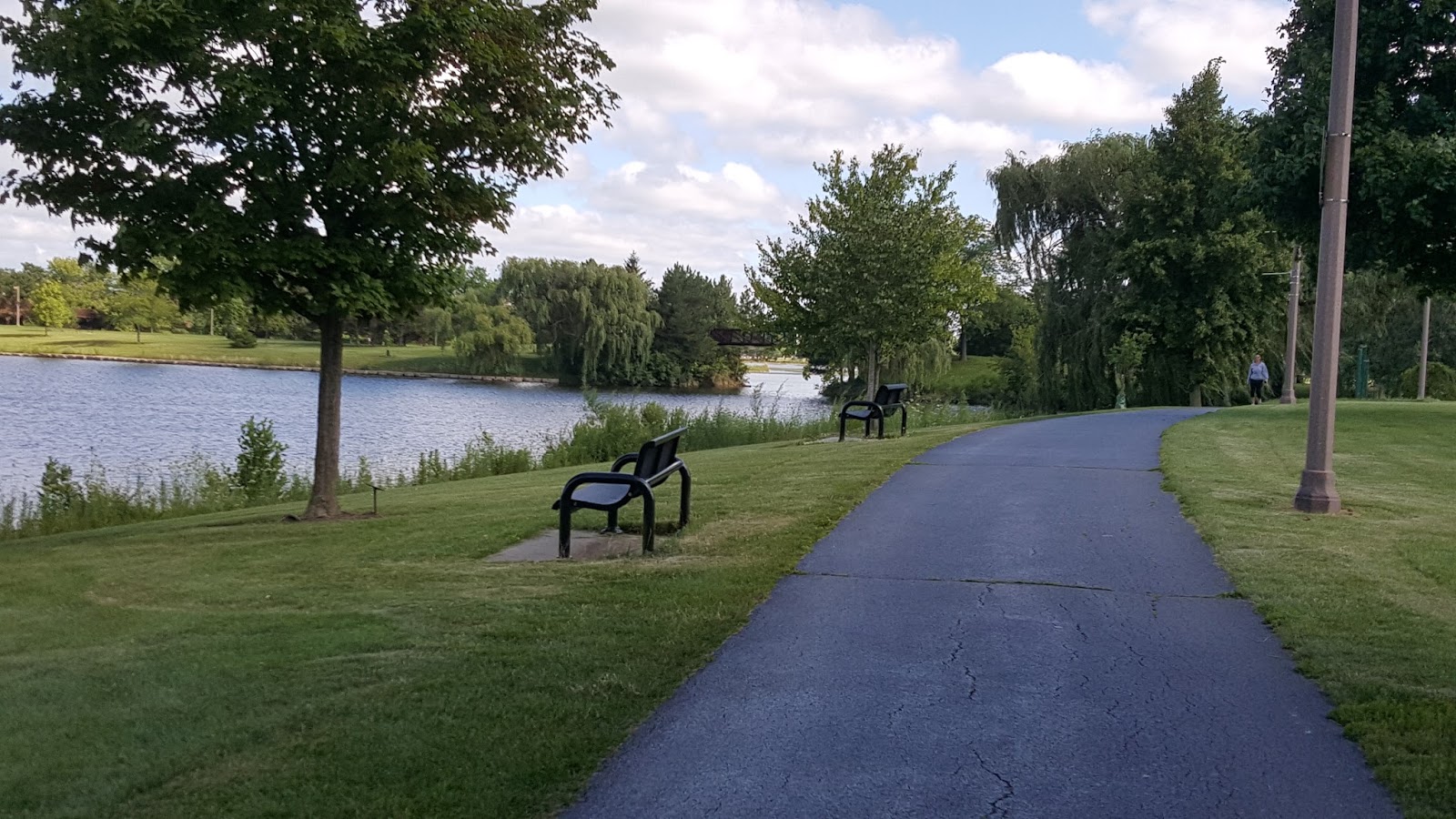


Walking around Century Lake in Vernon Hills with my mother.


I continue to help administer two Camino-related Facebook groups which keeps me in touch with the other walkers, and makes planning my own walk easier.  If I wanted to, I could just pose questions and see what others recommend or think on any related subject.  On the Feast Day of St. James, July 25, Brooke Taylor posted the article reproduced below.  If you recall, she was the woman I met in Paris in the spring through the Via Podiensis FB group. She was soon to be walking the Vezelay route.

How the scallop shell became a symbol of pilgrimage          by Philip Kosloski


There are numerous legends and myths surrounding this well-known symbol.


For those familiar with the Camino de Santiago pilgrimage, the scallop shell is a welcome sight. It is a symbol that guides pilgrims along the way towards their ultimate destination, and is frequently worn by those who embark on such a journey. 

   The scallop shell can also be seen in medieval representations of St. James the Greater as well as basic depictions of pilgrims. It is an ancient symbol, one that has become closely associated with the Camino and Christian pilgrimage in general. 

   Why is that? How did the scallop shell receive such an association? Part of it was due to certain legends surrounding the arrival of St. James’s body in Spain. One story recounts that after James was martyred in Jerusalem in the year 44, his body was taken to Spain and when the ship reached the shore a horse was spooked and fell in the water. The story goes on to say how both the horse and rider were miraculously saved and came forth from the water covered in scallop shells. 

   On a more practical level scallop shells are naturally found on the coast of Galicia near the location of St. James’s tomb. For pilgrims in the Middle Ages the journey was typically done to fulfill a penance given by a priest. In order to verify that the pilgrim did in fact reach the final destination, a local souvenir was required. Over time pilgrims began to take the scallop shells they found and then presented them as proof when they returned home.  

  At first pilgrims who wanted a scallop shell had to continue the journey past the tomb of St. James to Finisterre, but by the 12th century vendors saw the lucrative opportunity and began selling the shells near the cathedral. 

   Besides being a souvenir for pilgrims, the scallop shell was also used as a bowl for food and water. From this close association with the Camino the scallop shell was more generally known as a symbol of pilgrimage. It was used to symbolize the Christian’s journey towards heaven, evoking the Letter to the Hebrews and how we “are pilgrims and strangers on the earth” (Hebrews 11:13).  The Catechism further explains how, “Pilgrimages evoke our earthly journey toward heaven and are traditionally very special occasions for renewal in prayer. 

 For pilgrims seeking living water, shrines are special places for living the forms of Christian prayer” (CCC 2691). With this in mind the scallop shell was also used in the administration of the sacrament of Baptism. Not only did it prove to be a practical tool to pour water on someone, it also carried that same symbolism of pilgrimage with it. Baptism is the start of the Christian journey and so when a priest uses a scallop shell to pour water on a child, he is initiating that child on a pilgrimage towards heaven. This is also why the scallop shell can often be seen artistically represented in baptistries or on baptismal fonts. The scallop shell is an ancient Christian symbol, one that has a long and rich history.


Then in early August, I got together with another pilgrim, Janet Booth, who needed some help planning her Le Puy walk.  We met at the La Madeleine restaurant in Rockville, now relocated to the new Pike & Rose shopping area which was a perfect place because it was not crowded and there was the possibility of bottomless coffee. Another advantage is that there is free wifi at the restaurant, so I was able to bring my computer and to show her some images for her upcoming walk from Aumont-Aubrac to Moissac in September.


I've taken one walk with my dogs around Lake Frank a couple of days ago and have also managed a 7 mile hike at Burke Lake Park (VA). I took my nephew with me since he has now moved in with me and will be staying for the school year. He will be doing his first year of teaching at DC Public's charter school, Mary McLeod Bethune Day Academy, and had nothing to do this weekend as his current girlfriend has now returned to Blacksburg, VA.


I have also been emailing the places where I plan to stay in September, and have received email  confirmations from all, so I am feeling quite pleased. There will inevitably be challenges, but the more I have addressed early, the better.  Now my train and plane reservations are also all in order as well, so my trip is shaping up.

Monday, July 10, 2017

The Halcyon Days of Summer

I was in Marshalls the other day when I stumbled upon two things that I've been looking for for awhile--both something that would serve as a small daypack (the backpack I usually take with me on hikes is larger and more cumbersome than I'd like, and my waist-pack is not big enough), and a hydration bladder system to use in my backpack.  I managed to get both for almost the price of the hydration bladder itself! This will now allow me to have a small daypack for hikes, and use the hydration reservoir system in my normal backpack which is was designed to accept such a bladder and tube setup.  As you can imagine, I am quite pleased with my purchase!


The hydration pack is an 18 liter size, and the bladder itself accepts 2 liters which is perfect for my needs.

 So naturally I looked for a chance to try it out.  The next day (Saturday) I got to break it in, walking with the Mid-Atlantic Hiking Group in nearby (to me anyway) Derwood, MD at the Agricultural History Farm Park. This Montgomery County (MD) park is some 455 acres and features barns, historic buildings, a modern farming activity center, etc. none of which we visited.  It might be worth investigating for a future trip, as I had never heard about it before this excursion.  On the other hand, the signage could have been better (we got lost twice), but it was a good group of people and a nice way to enjoy the morning exploring an unfamiliar landscape.


One sad little interlude, though.  My sweet little sausage dog Zoë  didn't want to leave her crate Saturday to walk after dinner, and I had to carry her outside.  At first I thought she was just not feeling well as she had regurgitated some of her dinner, and appeared unusually sad and forlorn.  She also refused to walk and her hind legs seems a little wobbly.  I look her to the Metropolitan Emergency Veterinary Clinic the following morning and she has apparently ruptured a disc in her spine--IVDD  they call it--Intervertebral Disc Disease.  This is just before a cross-country car trip to visit my mother for two weeks in Illinois.  Unfortunately, it is going to be a long road back for her as well, I'm afraid. . .  No more walks by the lake and to the park for a long, long while. . .


The good news, however, she is still able to use her hind legs, but strict crate rest has been prescribed for two weeks.

Thursday, June 15, 2017

And continues . . .

For those of you unaware of this, if you click on the header above, you will be carried to the actual blog, which might be easier to read than this email!

 As you know I'm an administrator for two different Camino Facebook groups.  Among all of the posts that come my way, a posting from the Forum des Chemins de Pélérinage that I've mentioned in the last two postings.  They put together a little video and I noticed that my image flickered by twice at the beginning of the clip.  Very brief--you'd have to be looking for me in the audience to notice, but it was fun to see myself--a complete surprise!  Here's the link.

And here's a screenshot of the better of the images. As you can see, most of the people are in my age bracket.


The hikes and group dog walks continue.  A long walk near Jessup in Savage Mill Park with the Mid-Atlantic Hiking Group actually came a little closer to the feeling of walking these pilgrimage trails in Spain and France, because of its cultural component.  It was a long hike--9 miles but broken up a bit with a walk through part of the historic town, providing a nice break to the physical walking experience.  The name Savage came from John Savage, a 19th century merchant from Philadelphia who invested in land in the area and created the Savage Mill, contributing to the cotton mill industry and the eventual growth of the town into a major industrial center during that century.  Originally they made sails for the clipper ships that sailed out of Baltimore harbor, and later field tents, army uniforms and vehicle covers. In 1935 the B & O Railroad came through the town and mid-century an iron truss bridge was built which would accommodate the trains.
Crossing the Bollman iron truss bridge


Savage Mill Mansion
The old mill itself has today become a complex of shops and restaurants.

And then a walk with the Mid-Atlantic chapter of American Pilgrims on the Camino.  I have rarely been able to participate with them because of the timing of their get-togethers, but I was able to make the hike on June 11, held at Black Hill Regional Park, with a pot-luck dinner following.  I was accompanied by my friend Rhonda Daniels, who had also walked from Sarria to Santiago de Compostela about the same time that I did in 2013.  It was a scorcher of a day, but cooler in the shade of the woods, and 28 of us walked a little over 6 miles, often along the edge of Little Seneca Lake.


We take a break


Rhonda in pink


Most of the group that walked

Dinner afterward


Friday, June 9, 2017

WARNING--BLOGGER PROBLEM

Recently there have been issues with Blogger.  I had a post from a year and 8 months ago re-posted, 3 of my blog entries changed from "published" to "draft" and, just yesterday, a "draft" published before I was finished writing it.  Also my entry for "Conques" (October 2014) got wiped out entirely. I don't know what is going on, but I just want you to know that I am not doing this intentionally.

Friday, May 12, 2017

The preparation continues

For those who read French, there is a nice write-up of the French Pilgrim forum written up here.


 And here I am in a frame of a short video they made of the conference.

Now that I'm back in the US (after returning from Paris/Burkina Faso)  I have been occasionally walking with local walking and hiking groups to stay in shape.  

Sometimes I have walked with various dog-walking groups.  Here I am at Riley's Lock walking along the C&O Canal in Poolesville.


And here I am in Greenbelt Park, walking with the the Mid-Atlantic 
Hiking Group.

Hikes on weekdays during the day usually ensure that most people will be retired and in my age bracket. It also usually means that they will likely walk at a pace closer to my own.


Spring walks are always lovely because the wildflowers are in bloom and the trees are beginning to leaf. 

I am concerned about my hip (I had partial hip surgery in 2012) and an arthritic knee which act up from time to time.  I occasionally have unexplained shin-splints so I have bought some compression sleeves for my legs. I'm testing these out, using them on my walks to see if they seem to have any benefit.

I can't let a few arthritic joints hold me back, though, because I know that if I stop exercising, they will only continue to degenerate. Below are some additional photos of a walk with a few members of the Mid-Atlantic Hiking Group at the Rachel Carsen Conservation Park in Brookeville, MD.  I try to take advantage of any hikes they have during the week that are held in the morning--which are rare.  Usually they cater to working people with evening or weekend walks which I try to avoid.  I miss the disappearance of the Silver Spring Outdoors Meetup Group that I used to frequent in previous years, but I guess nobody wanted to take responsibility for running it because it was a lot of work researching and planning regular activities.


So ultreïa!*


* The word Ultreïa stems from a mixture of Latin and Old French meaning "beyond." It used to be shouted between pilgrims during the Middle Ages as a wish of an unfailing courage.